

October 2025
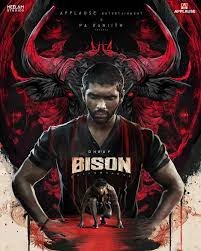
Bison – Kaalamaadan: Another Fierce Artistic Creation by Mari Selvaraj!
In recent years, I have lost the enthusiasm to go to theatres to watch films. Most Tamil films today glorify exaggerated heroism, indulge in blood-soaked violence, force unwanted comedy rely on double-meaning dialogues. These are very far away relevant for a person in real life. To make things worse, there is a craze for box-office madness — racing towards 100 or 1000 crore collections. It has become rare to find a good film suitable for a family with small kids to watch together. So, I prefer to watch genuine films patiently on OTT platforms — though I rarely feel like writing about them.
However, when I watched Pariyerum Perumal, its depth, artistic strength, and the mature way it handled the issue of caste left a lasting impression on me about Mari Selvaraj. His later films Karnan, Maamannan, and Vaazhai further established him as a socially responsible artist and a talented director capable of delivering meaningful cinema in Tamil.
While learning more about him, I discovered he was also a writer. Reading his acclaimed book Thamirabaraniyil Kollappadatha Vargal (The Unkilled of Thamirabarani) shook me deeply for almost a week. The book opened up the red-soiled landscapes of the South — the very memories of of his childhood with poetic intimacy.
After reading his works Marakkave Ninaikkiren, Sambadi Aattam, and the poetry collection Uchhini Yenpathu, I realized that what Mari shows us on screen is only a minute fraction of what he writes. In Bison, Ameer’s character Pandiyaraja commits a murder and flicks off a piece of flesh stuck to his bloodied face. Like that same raw moment, Mari exposes through his writing, the haunting truths society hesitates or refuses to show us.
For people like me, who live in small town who rarely encounter caste directly, Mari’s world reveals invisible layers of society hidden within our own.
Women in Mari’s World:
One striking feature of Mari’s creative world is his powerful portrayal of women — especially elder sisters (“akkas”).
In an interview, he said,
> “It is because of the compassion and support of the women in my world that I am here. The first and last faith of a man lies in a woman.” <
These words find expression in the way he shapes his female characters — symbols of resilience and moral strength that inspire the next generation to treat women right.
Nature as Metaphor:
Mari uniquely uses land, plants, and animals as metaphors for human emotions and struggles:
Pariyan’s dog Karuppi
Karnan’s horse
Maamannan’s pig
Vaazhai’s cow
Bison’s goat
Each becomes a living symbol of the people’s pain, resistance, and innocence.
The contrasting images — the lush green banana groves against the barren life of those field labours in Vaazhai — or the poetic camera frames in Bison like Dhuruv walking through a rice field with a banana tree across his shoulder — reveal filmmaker’s love for poetic frames.
Mari often uses bird’s-eye shots — perhaps suggesting a divine or ironic gaze of God upon human suffering.
Faith and Folk Spirituality:
In Karnan, the goddess of the village; in Bison, the deity Kaalamaadan — both represent the last source of faith for people abandoned by systems, leaders and also fellow humans.
This connects deeply with South Tamil Nadu’s folk spiritual traditions — where gods are not distant saviors but reflections of people’s pain and endurance.
A Politics of Dialogue, Not Violence:
Mari’s politics do not glorify violence or caste pride. Instead, he calls for open, unfinished dialogue — a form of resistance rooted in empathy.
This vision is not just justice based; but very essential for Tamil castes unity and harmony with the background of tamil nationalism’s rise.
Art, History, and Responsibility:
For centuries, the true history, art, and literature of Tamils have not been represented enough as they are largely due to political suppression.
Across the world, art often reflects the land, people, and their lives.
Tragically, in Tamil society, this connection between the Ground Zero and the art has been deliberately severed.
That’s why films like Bison are essential — to bridge this forced distance.
Art as a Mirror of Humanity:
Mari Selvaraj’s creative universe — his films, writings, and speeches — reflect land, people, animals, beliefs, and gods with raw truth.
They speak of the bitter realities we hesitate to think, speak, or confront.
They may disturb some, but they cannot be ignored anymore.
Thus, Mari Selvaraj’s impact on contemporary Tamil cinema is profoundly healthy and necessary.
His mentor Director Ram, producer Director Ranjith who introduced him, and his team deserve gratitude from Tamil society for enabling such truthful art.
Conclusion:
Art exists to refine humanity to tame the primal instincts that evolution left within us, to foster cooperation and empathy.
Every civilized society examines itself through the mirror of art — cleansing and correcting its flaws.
In that sense, Mari Selvaraj’s Bison is not merely a film; it is a kaleidoscope of society — a layered mirror reflecting who we are and what we must confront.
Mrs. Vimalini Senthilkumar,
Policy Propagation Secretary,
Senthamizhar Paasarai – Valaikuda (Gulf wing NTK)